CityGMLOpen Source
CityGML meets Blender: From visualization to editing
3D city models based on CityGML have so far primarily been used for visualization, with only limited options for editing. This is exactly where our Blender add-on comes in. Read here how a passion project by our developers evolved into a comprehensive open-source solution for practical use – and the possibilities it unlocks.


With the Blender add-on, traditional CityGML data is transformed into fully featured Blender scenes.
These can be
- visually inspected,
- selectively edited, and
- converted back into structured CityGML data.
This creates a continuous workflow – from the data source to reintegration into existing systems.
What the add-on enables
The add-on extends Blender specifically for working with semantic 3D city models: CityGML data (2.0 & 3.0) can be directly imported, edited, and exported again – both file-based and via connection to 3DCityDB using PostgreSQL/PostGIS. Semantic structures such as buildings, building parts, and surfaces are preserved and remain editable throughout the process.
Materials, textures, and attributes are also supported, complemented by validation and automation features as well as tools for handling large datasets.
Specialized functions such as the ModelTyper and the Openings Cutter further enable targeted editing of semantic elements like walls, roofs, windows, and doors.
A particularly smart feature: the add-on can be used not only via the Blender GUI, but also in headless mode, making it suitable for integration into automated workflows.
The crucial advancement lies in the end-to-end workflow:
- Import from CityGML files or databases
- Editing and enrichment in Blender
- Export back to CityGML or directly into database structures
For the first time, this makes it possible not only to visualize existing datasets but to actively develop them further—without media breaks between GIS, databases, and 3D environments.
Relevance for Urban Digital Twins
Particularly in the context of urban digital twins, the add-on opens up new possibilities:
- Iteratively develop existing city models
- Enrich semantic information in a targeted way
- Feed changes directly back into data repositories
- Integrate workflows more closely between planning, analysis, and visualization
This makes Blender an integral part of modern data pipelines.
Open Source and Community
The Blender add-on is open source (MIT License) and freely available to the community. The goal is to collaboratively develop a powerful solution for working with CityGML and 3D city models.
It was primarily developed by Oliver Förster as a “passion project” and is now available as an open-source solution. At Virtual City Systems, we actively encourage such individual initiatives in order to turn innovative ideas into practical solutions for our customers and the wider community.
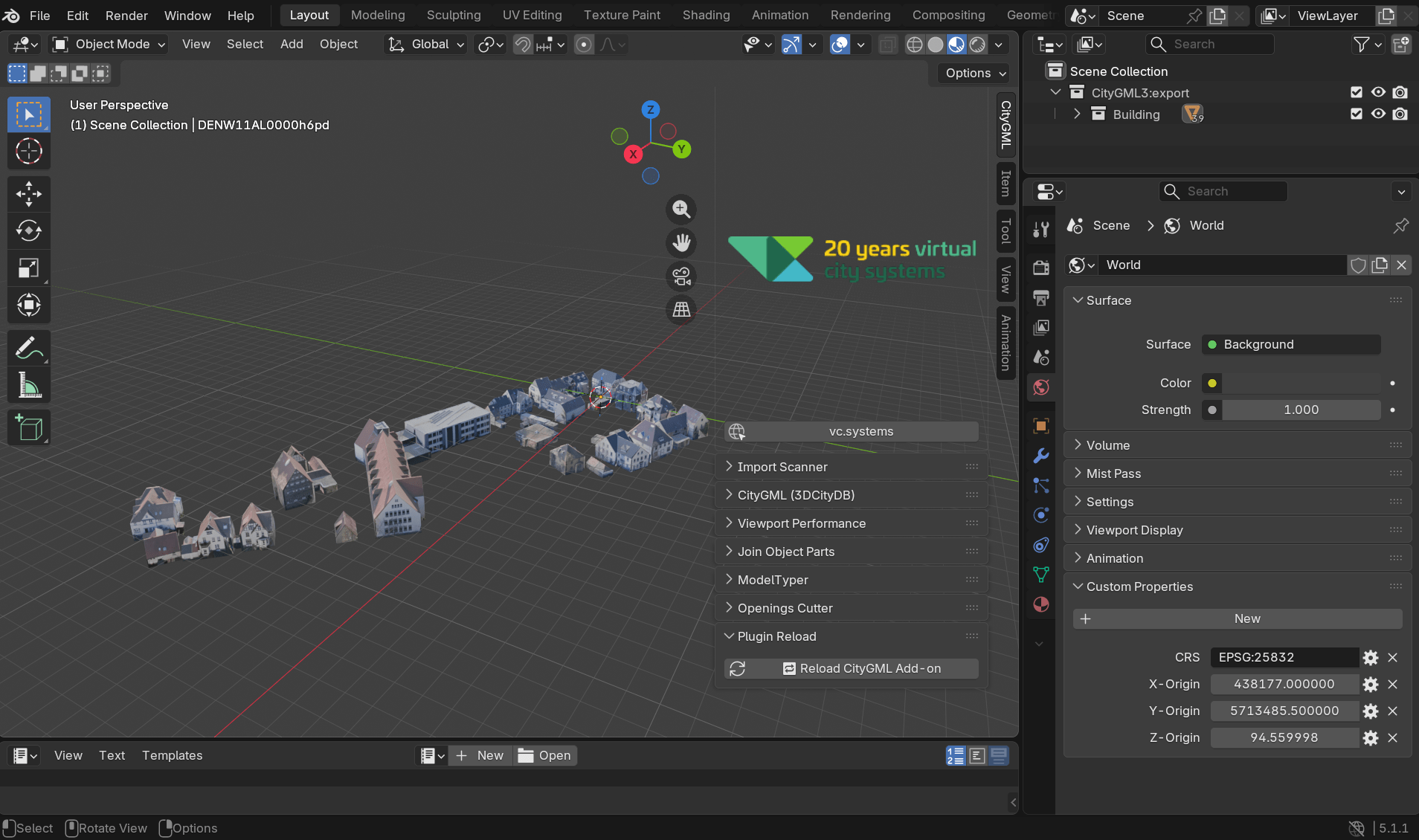
CityGML data is loaded into Blender, edited, and reused within the existing data structure.
Try it out and get involved:
The Blender add-on in practice
At our workshop at the 3D-Forum in Lindau in May 2026, this was demonstrated in practice: in a short live demo, our Junior Developer Oliver Förster showed how an existing CityGML building model can be imported into Blender and edited in a targeted way.
As an example, he added a door and a window to the model, illustrating how such changes can be implemented in a semantically correct manner.
The edited model was then exported again and visualized in the application via the VC Publisher. This clearly demonstrated how the workflow – from editing through to visualization in the digital twin – can be implemented seamlessly and in a practical, end-to-end process.
On YouTube, we have shared a video that demonstrates the functionality and capabilities of the Blender add-on:

"What excites me about the Blender add-on: raditional CityGML data becomes fully editable, visually verifiable, and re-exportable Blender scenes—complete with textures, materials, UVs, filters, XSD validation, and even workflows for handling large datasets."