CollaborationEnergy ProvidersPartnersUrban Digital TwinWebinar
Digital Twin for Energy Providers: How MITNETZ STROM Is Taking Grid Planning into the 3D Era
As part of our webinar on November 19, 2025, MITNETZ STROM, GISA and Virtual City Systems provided exclusive insights into a joint project: building an Urban Digital Twin for energy infrastructure. The goal is to interlink grid data, accelerate processes, and unlock new dimensions in planning.



Webinar Recap: Urban Digital Twins in Action at MITNETZ STROM
How do you plan a new substation? How can grid networks be better visualized, operational risks identified earlier, or permitting processes sped up? The answer to these and many other questions lies in a Digital Twin that goes far beyond traditional 3D visualization.
During the webinar, MITNETZ STROM, GISA and Virtual City Systems shared a project that is setting new benchmarks for digital grid planning: an Urban Digital Twin that maps the entire grid area—including substations, transmission corridors, assets, and operational data—in 3D, serving as a central platform for data integration, planning, and operational support.
Digital Infrastructure Needs Digital Planning Platforms
Grid operators face major challenges: grid expansion must happen faster, permitting processes must run more smoothly, and information must be more centrally accessible. This is exactly where MITNETZ STROM’s Digital Twin comes into play.
The goals:
- Bring all relevant grid data into one system
- Convert 2D GIS data into realistic 3D models
- Digitally connect planning and operational processes
- Interface with existing systems such as GIS, asset management or Primtech
- Provide user-friendly visualization for all roles: from planning to maintenance
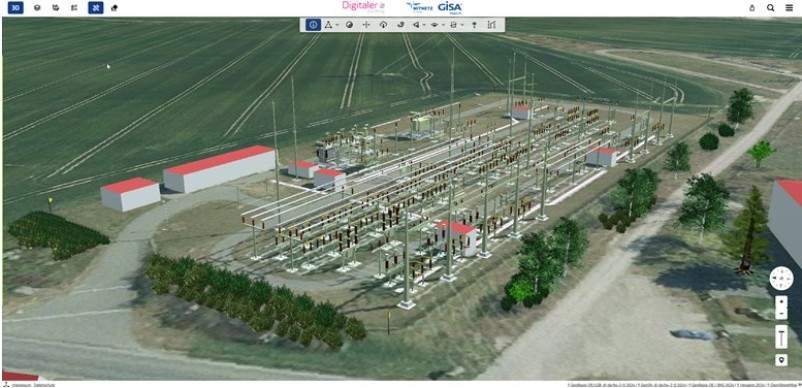
3D model of the Falkenberg substation as a digital twin
“Our vision is to bring together a wide range of data streams—from Lidar to asset information—and make them usable via a spatially connected platform.”
From Proof of Concept to Operational Platform
The starting point was a 3D model of a substation developed as a proof of concept. This has since grown into a platform that:
- Processes over 100 Lidar-based point clouds
- Represents more than 250 transmission corridors with realistic 3D transmission line models
- Visually presents the condition of assets using risk scores
- Integrates 3D panoramic images for remote maintenance and inspection
- Supports planners in site selection and volume calculation via a terrain module
Typical Use Cases for Grid Operators
The platform supports the following use cases, among others:
- Site selection & early-stage planning: Parcels, protected areas, flood zones and proximity to infrastructure are analyzed directly in the 3D model.
- Substation planning & variant comparison: Standard models can be placed, evaluated and exported.
- Asset management & operations support: Equipment condition is displayed via color coding; 3D panoramas support maintenance and incident handling.
- Permitting processes: Realistic 3D representations help explain complex projects to authorities, decision-makers and the public.
- Municipal collaboration: Additional topics such as district heating planning or solar potential analysis can be integrated.
“This has truly become a passion project for us – it shows what can be achieved when practical use cases, strong partners, and technical depth come together.”
VCS Technology as the Foundation
The technical foundation for the Urban Digital Twin is VC Map by Virtual City Systems. It enables the integration of a wide variety of data sources—from Lidar scans and WMS services to asset databases—and links them spatially via open standards such as CityGML. With add-ons like the terrain tool, planning libraries and 3D panorama viewer, key processes like site analysis, variant comparison and operational support can be handled directly in the browser.
Thanks to its modular interfaces and system-of-systems approach, VC Map allows GISA and MITNETZ STROM to extend their existing IT landscape without disrupting or replacing existing systems.
Conclusion: Digital Twin as a Cornerstone of Grid Transformation
What MITNETZ STROM is implementing together with GISA and Virtual City Systems demonstrates the practical potential of Digital Twins in the energy sector. The platform not only increases transparency in grid infrastructure, but also connects information, stakeholders and systems in a way that was not previously possible. The Urban Digital Twin is becoming the cornerstone of modern, flexible and data-driven grid planning.