Helsinki: From an automated 3D city model to a living, continuously updated Urban Digital Twin
How Helsinki uses automated processes to bring its 3D city model to life and create a continuously up-to-date data foundation
Automating Urban 3D Data for Living Digital Twins
Helsinki has taken a decisive step toward a fully automated, always up-to-date 3D city model. With a bold shift from manual updates to nightly, incremental processing, the city now ensures that its 3D building models match the precision and timeliness of its 2D footprint data.
The result: planners, architects, and Digital Twin applications work from the most current data available without delay, without guesswork.
„Our goal was simple yet ambitious: to make our 3D city model as reliable and current as our 2D footprints – and to get there through automation.“

Keeping the 3D Model in Step with the City
At the heart of Helsinki’s approach is one clear ambition: to keep the 3D building models as current as the 2D footprint database, enabling precise visualizations for planning, Digital Twins, and stakeholder projects.
The main use case is a fully automated chain: the system detects changes in the 2D dataset, identifies new or modified buildings, updates the 3DCityDB with attribute changes, and prepares 3D model tiles for BRec so modellers can start work the very next day. Any completed models from the previous day are imported into the database, and once the 3DCityDB is up to date, the 3D application layers are automatically refreshed.

Figure: Automated FME workflow keeping Helsinki’s 3D city model up to date every night.
This ensures that planners, architects, and Digital Twin consumers always have access to the most recent 3D data. Beyond that in the near future, the workflow enables the visual integration of new IFC building models into the city model, supports historical versioning, and lays the groundwork for similar automated maintenance processes for other city assets, such as trees or traffic areas.
From Sporadic Updates to Continuous Accuracy
Helsinki’s 2D building footprint database, which is maintained in Oracle and based on precise field measurements, had long been a model of accuracy. But while the 2D data was continually updated, the 3D building models, first created in 2016, lagged behind. Years of partial or manual updates had left the 3D City Database (3DCityDB) out of sync.
The challenge was twofold:
- Keep the 3D models as current as the 2D data, even before construction is complete.
- Replace outdated models without losing historical versions, while accommodating less accurate legacy data from past decades.
The solution needed to be scalable, compatible with Helsinki’s existing tools. Starting from the beginning of next year, the new Building Act and Building Information Modeling (BIM) decree will require BIM-based building permit processing based on the IFC standard, which will even more ease the manual modeling work, as the first version of the new building will be converted straight and automatically from the IFC model.
Clear Criteria, Strategic Decision
When assessing possible approaches, Helsinki defined four decisive requirements:
- Automated version control – replacing outdated models while retaining historical records.
- Seamless integration – working with FME for automation, BRec for modelling, and the VC Publisher API for efficient incremental updates.
- Scalability – capable of processing hundreds or thousands of changes each month.
- Future readiness – enabling IFC integration without disrupting existing workflows.
„The ability to update incrementally instead of reprocessing everything was a game-changer for efficiency.“
Implementation: A Nightly Workflow at City Scale
Helsinki built a fully automated nightly workflow around:
- FME Form to orchestrate multiple workbenches:
- Compare 2D footprints with the 3DCityDB.
- Create new modelling tiles when changes are detected (for the new version of the building, the same gmlid will be used).
- Reuse modelling components from existing models (via Python scripts extracting from legacy BREC SAVX files) to save significant modelling time.
- Validate and update building attributes from the base register.
- Check the status of the building and make changes if needed (planned, under construction, completed, demolished).
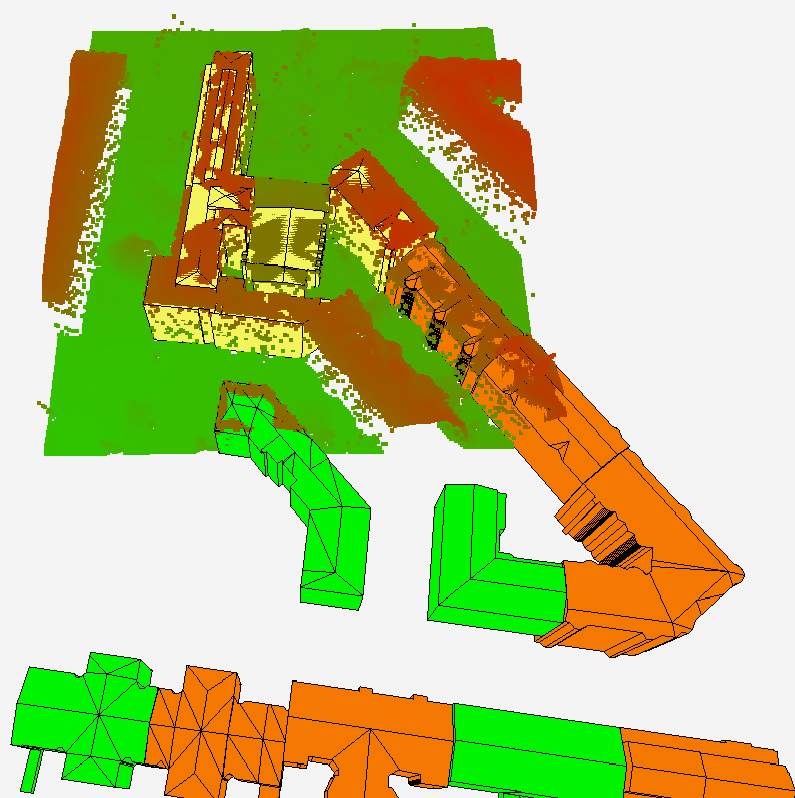
Figure: Representation of the building in Helsinki’s 2D footprint database.
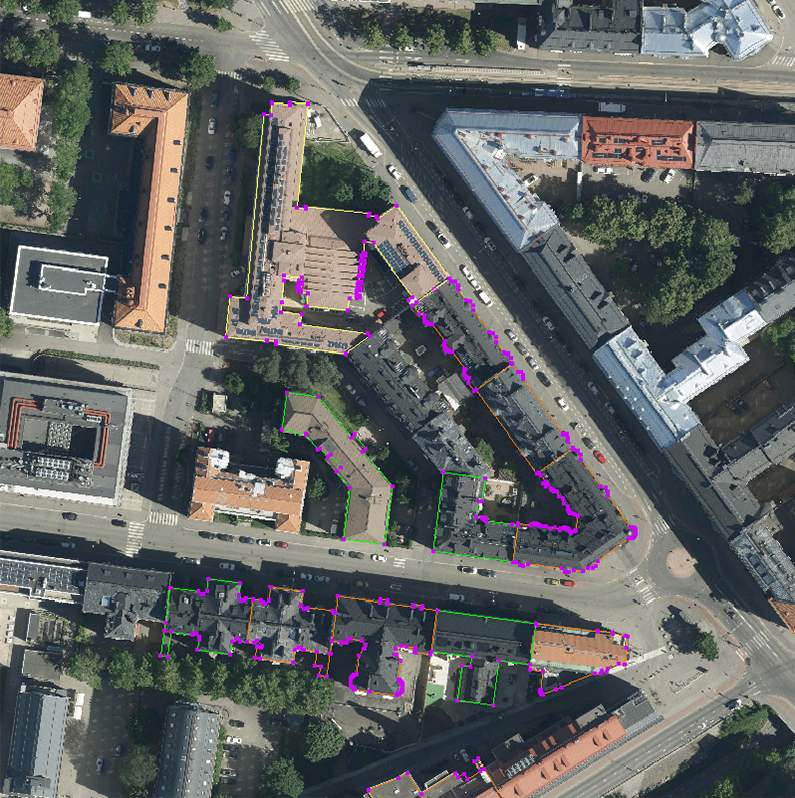
Figure: Corresponding 3D representation of the same building in the City Database.
- FME Flow for address search and exports:
- Address search API.
- VCS FME Workbench for exporting data.
- BRec for modelling new or altered buildings.
- VC Publisher REST API:
- import modeled CityGML files.
- Update partially 3D tile sets, avoiding full dataset reprocessing.
- Oracle Databases for footprints and attribute registers.
- Automated HTML reporting of daily changes and modelling status.
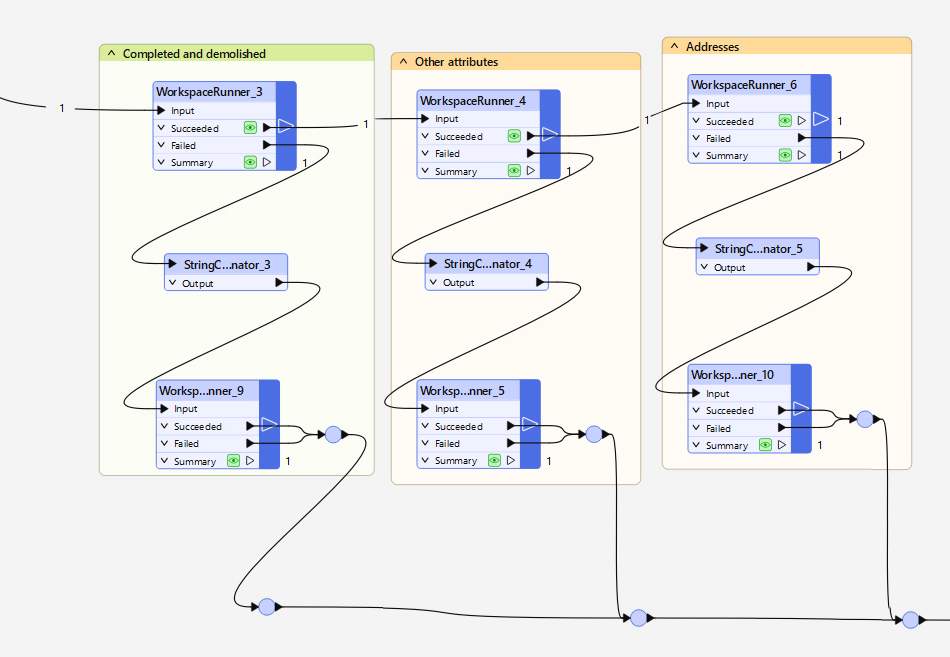
Figure: Automated workflow for updating building status, registers, and addresses.
Running on Windows Task Scheduler, the system updates six different 3D tilesets every night – textured and non-textured LOD1 and LOD2 models, plus demolished buildings – ensuring citywide coverage.
Benefits: Speed, Precision, and Digital Twin Readiness
The transformation has turned 3D model maintenance from a manual, occasional task into a nightly, near real-time process. The benefits are tangible:
- Always-current data for planners, architects, and stakeholders.
- Time savings through geometry reuse.
- Robust framework ready to extend to other datasets like trees (approx. 2.9 million) or traffic areas.
By building directly on the most recent BRec changes, the workflow avoids redundant work and significantly increases modelling efficiency.
This smart reuse of existing modelling info not only saves time, it also ensures that decision-makers, planners, and citizens have the confidence that the city’s Digital Twins reflect reality at any given moment. By removing delays and manual bottlenecks, Helsinki fosters faster collaboration and more informed urban planning.
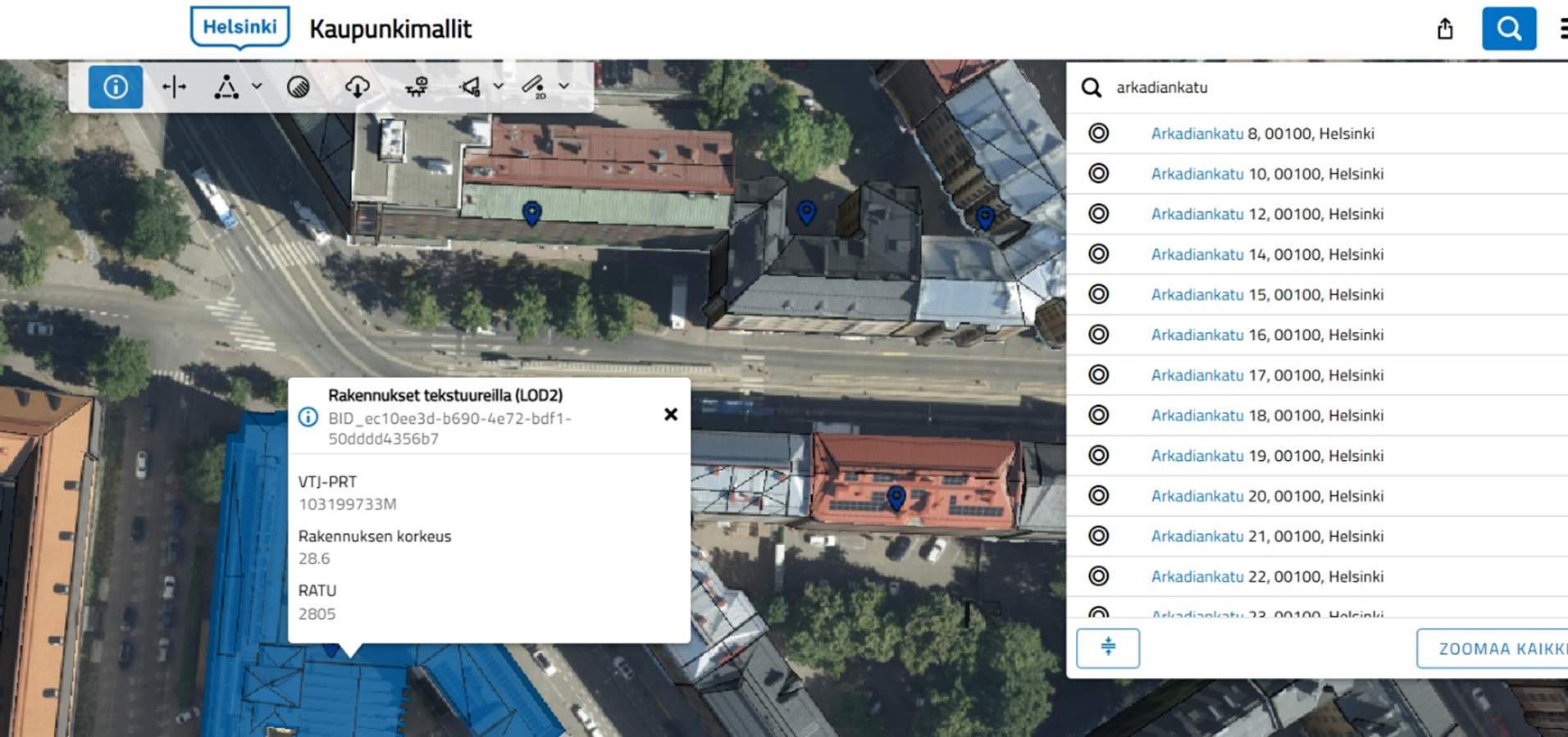
Figure: Initial 3D building representation in VC Map before attribute enrichment.
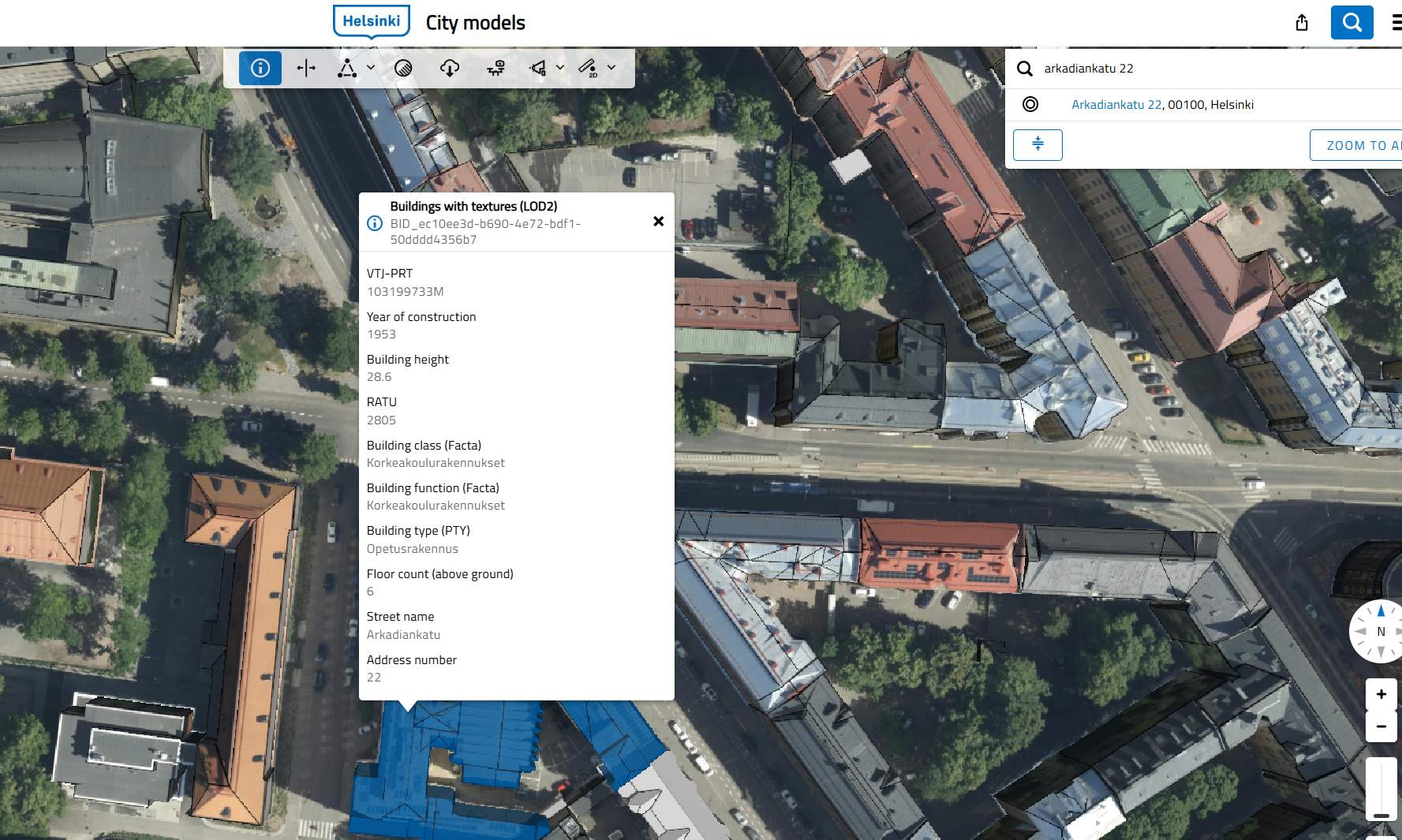
Figure: Updated 3D city model in VC Map with enriched building attributes.
„We see this not just as an efficiency project, but as building the backbone for our Digital Twin future.“
Outlook: Expanding Automation Across the City
The city’s next steps include:
- Automating texture generation from oblique and nadir imagery.
- Leveraging IFC models from building permits to bypass manual modelling for new buildings entirely, potentially using tools such as the IFC_BuildingEnvExtractor.
- Applying automation to other urban datasets via lidar classification and annual updates (e.g. forest areas trees).
By year-end, Helsinki aims for a one-to-one match between 2D footprints and 3D models, fully maintained in near real-time and ready to power the city’s Digital Twin vision.
This roadmap reinforces Helsinki’s commitment to truly living Digital Twins. One that evolves in step with the city itself, day by day.
Future readiness with automation, seamless integration, and scalability
Are you looking for a way to always work with the most current version of your Urban Digital Twin without delay? We would be happy to show you how to make the shift from manual updates to incremental processing.
„Projects like Helsinki show how powerful automated workflows can be for maintaining city models. Instead of occasional updates, the model evolves together with the city.“
Henry Willem Farr, Head of sales